#1 Overall Winner
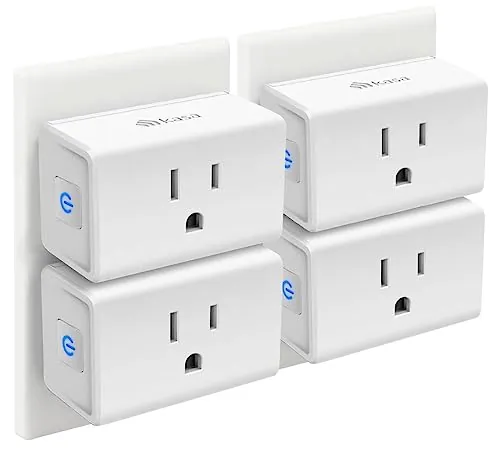
Kasa Smart Plug Mini 15A (EP10P4) 4-Pack
- Ultra-compact plug design that’s intended not to block a second outlet
Comparison
The Kasa Smart Plug Mini EP10P4 is a compact Wi‑Fi smart outlet pack designed to automate and remotely switch everyday devices, while the Levoit Classic 300S is a smart cool-mist humidifier built to manage bedroom and large-room humidity. Both support app control, schedules, and Alexa/Google voice control, but they solve very different household problems. If you’re choosing between them, the real decision is outlet automation versus comfort-focused humidification.
#1 Overall Winner
Contender
Choose the Kasa Smart Plug Mini EP10P4 if you want an inexpensive way to automate multiple outlets with schedules, voice control, and remote on/off. Choose the Levoit Classic 300S if you need a quiet, large-tank humidifier with Auto Mode and app-based humidity monitoring. If you’re building routines for a bedroom, they can also work well together (for example, humidifier plus scheduled lighting).
Overall winner
Depends on your needs
| Feature | Kasa Smart Plug Mini 15A (EP10P4) 4-Pack | LEVOIT Classic 300S 6L Smart Cool Mist Humidifier | Winner |
|---|---|---|---|
| Product type | Wi‑Fi smart plug (on/off) | Smart cool-mist humidifier | Depends |
| Primary use | Control power to devices (lights, fans, small appliances) | Add moisture to air in bedrooms/large rooms | Depends |
| Pack size / unit count | 4-pack | Single unit | Kasa Smart Plug Mini 15A (EP10P4) 4-Pack |
| Smart control | Kasa/Tapo app; remote on/off | VeSync app; mist control & monitoring | Depends |
| Voice assistant support | Alexa, Google Assistant (also mentions SmartThings/IFTTT) | Alexa, Google Assistant | Kasa Smart Plug Mini 15A (EP10P4) 4-Pack |
| Automation features | Schedules, timers, Away Mode | Schedules, Auto Mode (humidistat-based) | Depends |
| Connectivity requirements | 2.4 GHz Wi‑Fi only stated | Wi‑Fi for smart features; basic controls without Wi‑Fi | LEVOIT Classic 300S 6L Smart Cool Mist Humidifier |
| Electrical capacity | 15A / 1800W max load; 120V | 26W; 120V | Depends |
| Capacity / coverage | N/A (switching device) | 6L tank; up to 505 ft² stated | LEVOIT Classic 300S 6L Smart Cool Mist Humidifier |
| Noise suitability | Silent switching (no operating noise noted) | ≤30 dB claim; quiet sleep mode | Kasa Smart Plug Mini 15A (EP10P4) 4-Pack |
| Maintenance needs | Minimal after setup | Regular cleaning/refilling; water-quality considerations | Kasa Smart Plug Mini 15A (EP10P4) 4-Pack |
| Space efficiency | Ultra-compact outlet footprint | Counter/furniture footprint required | Kasa Smart Plug Mini 15A (EP10P4) 4-Pack |
| Safety notes provided | UL certified; flame-retardant materials; 15A rating | Auto shut-off; ETL certified; BPA-free material stated | Tie |
| Buyer feedback themes | Easy setup, reliable for many; mixed connectivity/Alexa reports | Very effective, quiet; cleaning can be tricky; value opinions vary | Depends |
In everyday home use, the Kasa plug is about convenience and control—turning existing “dumb” devices on/off from your phone, building schedules, or using voice commands. The Levoit is more of a comfort appliance: it runs for long stretches and is intended to make a room feel better during dry periods by adding humidity, with optional smart monitoring. If you want to automate multiple small routines across the home, Kasa fits more places; if you want a noticeable change in how a room feels, Levoit is the more direct tool.
For climate and comfort, the Levoit Classic 300S is the clear fit because it’s designed to manage humidity with a large tank, Auto Mode, and bedroom-friendly quiet/sleep settings. The Kasa plug can support comfort indirectly—such as scheduling a fan, controlling a bedside lamp, or powering a small humidifier on a timer—but it doesn’t measure or adjust indoor conditions on its own. If dry air is the problem, the Levoit addresses it directly.
Performance depends on the intended job. The Kasa Smart Plug Mini generally performs well as a responsive on/off controller, with owners frequently reporting smooth scheduling and practical everyday use (including automated power cycling for devices). Its main performance caveat is that some users experience connection or assistant-linking hiccups depending on network changes or setup order.
The Levoit Classic 300S is widely described as effective at humidifying bedrooms and running quietly, with Auto Mode helping maintain a target humidity level. Its performance is closely tied to maintenance: users who keep it clean report strong results, while neglected cleaning can create problems over time.
Reliability feedback is positive for both, but the risks differ. With the Kasa Smart Plug Mini, the most repeated issue is connectivity variability: many users have stable connections, while others run into disconnects or assistant-linking friction, particularly after router changes or when setup steps aren’t followed in sequence. Resetting and re-adding often resolves problems, but it can be an annoyance.
For the Levoit Classic 300S, reliability looks strong when maintenance is consistent, including reports of years of continuous use. The key reliability risk is hygiene/scale buildup: if cleaning is missed and hard-to-reach areas accumulate grime, performance can degrade and continued use may become undesirable.
The Levoit Classic 300S is purpose-built for humidity control, with a stated coverage range and Auto Mode that uses a built-in sensor to adjust output toward a set humidity target. This makes it better suited to maintaining consistent room conditions rather than just adding mist on a fixed setting.
The Kasa Smart Plug Mini does not control climate directly, but it can support simple climate routines (like scheduling a fan, heater, or a basic humidifier) as long as the connected device is safe to be switched and stays within the plug’s rated load.
Neither product is a dedicated security device, but the Kasa Smart Plug includes an Away Mode intended to simulate occupancy by switching connected lights on/off. The Levoit humidifier doesn’t provide monitoring or deterrence features; its role is comfort. If your goal is a simple security-adjacent routine (like automated lighting), Kasa is the more relevant option.
Neither product offers sensors, alarms, or camera-style monitoring. The Kasa Smart Plug Mini does include an Away Mode designed to switch devices such as lights on a schedule to simulate occupancy, which can be a small part of a home-security routine. The Levoit Classic 300S is a comfort device and does not provide monitoring or deterrence features beyond normal appliance operation.
Both products include safety-related details, but the risks are different because one switches power and the other uses water. The Kasa Smart Plug Mini is UL certified and rated for up to 15A/1800W; staying within that limit and using it with appropriate indoor devices is important. The Levoit Classic 300S is ETL certified and includes an automatic shut-off function, which is especially relevant for a water-based appliance running overnight.
For the humidifier, safe use also ties to hygiene: regular cleaning and appropriate water choice help reduce residue and buildup over time. For the smart plug, safe use centers on load limits and using it with compatible devices.
For comfort, the Levoit Classic 300S has the clearer impact because it can raise humidity and maintain a target level using Auto Mode—often a noticeable benefit in dry seasons or heated rooms. Sleep-focused touches like turning the display off also support bedroom comfort.
The Kasa plug improves comfort indirectly through convenience: automating lights, controlling appliances without getting up, or ensuring devices run on a predictable schedule. If your comfort goal is “better air feel,” Levoit is the stronger choice; if it’s “less hassle,” Kasa helps more.
The Kasa Smart Plug Mini is typically the easier day-to-day product: plug it in, add it in the Kasa app, and many users report being up and running quickly. A few reviews note that setup can become confusing when changing routers, but resetting and re-adding devices usually resolves it.
The Levoit is easy to refill thanks to the top-fill design and can be operated without Wi‑Fi using the touch controls. However, it asks more from you over time—refilling and cleaning—so “easy to use” depends on how comfortable you are with ongoing upkeep.
The Kasa Smart Plug Mini is designed to be unobtrusive: an ultra-compact body meant to avoid blocking a second outlet, with a straightforward push-button on the unit. It’s easy to place almost anywhere you have an outlet.
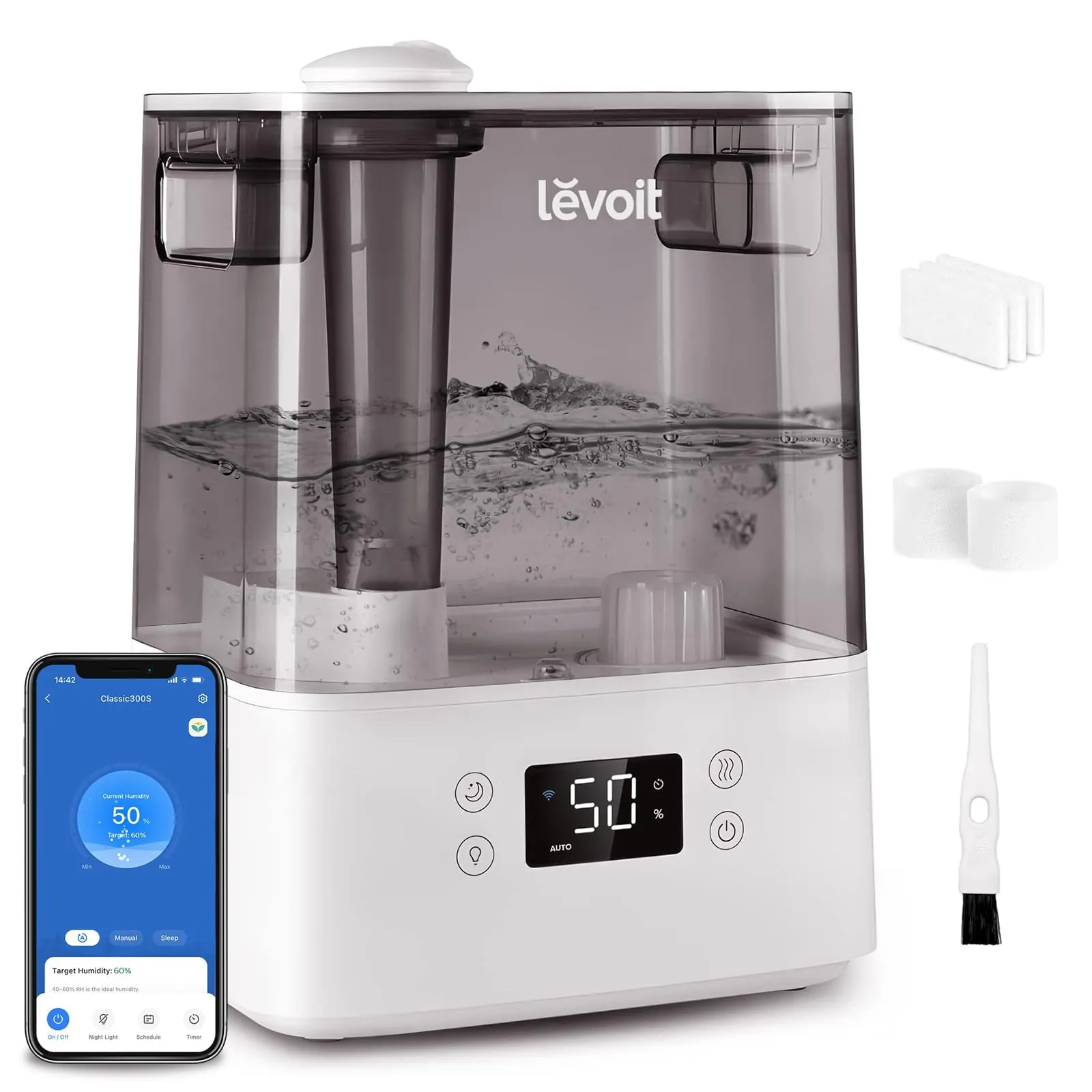
The Levoit Classic 300S is a larger, square-profile humidifier intended for a bedroom or living space. Its top-fill approach improves daily usability, and features like a display-off option are helpful for light-sensitive sleepers. Placement matters more: you’ll need a stable surface and a location that makes refilling and cleaning convenient.
Capacity applies mainly to the Levoit Classic 300S: it has a 6L water tank and is rated for up to 505 ft² coverage, aiming to reduce refill frequency (with up to 60 hours claimed on low). The Kasa smart plug doesn’t have a comparable capacity measure, but it does come as a 4-pack, which effectively increases how many outlets you can automate at once.
Space efficiency strongly favors the Kasa Smart Plug Mini. It’s designed to be compact and is meant not to block the second outlet, which matters in tight wall-socket locations and behind furniture.
The Levoit Classic 300S needs a dedicated footprint on a table, dresser, or stand, and you’ll want room for safe mist dispersion and easy top-fill access. In a small bedroom, it can still work well, but it takes up visible space in a way a plug does not.
Noise is mostly a factor for the Levoit Classic 300S, which is designed for quiet operation and is listed at ≤30 dB on low, with many users describing it as barely audible at night. The Kasa smart plug itself doesn’t produce ongoing operating noise, so it won’t affect a room’s sound level beyond the device you’re switching (for example, a fan or lamp).
Both products are essentially plug-and-place, with no permanent installation required. The Kasa plug installs by plugging into an outlet and completing in-app setup on 2.4 GHz Wi‑Fi. The Levoit humidifier involves placing the unit on a stable surface, filling the tank, and optionally connecting it to Wi‑Fi for app control; it can also be operated without Wi‑Fi using the device’s touch panel. Neither requires tools for basic setup, but the humidifier does require ongoing placement considerations for refilling and cleaning access.
Buyer feedback on the Levoit Classic 300S frequently mentions sturdy parts and a well-made feel, and some owners report multi-year use when maintenance is consistent. The Kasa plug’s build is more about compactness and safe materials, with UL certification and a simple physical form factor.
Neither listing provides deep material breakdown beyond basics (polycarbonate for Kasa; BPA-free materials for Levoit), so the practical difference comes down to complexity: the humidifier has more parts to keep clean and functioning, while the smart plug is a simpler device with fewer failure points.
The Levoit Classic 300S has credible long-term durability signals in reviews (multi-year use without issues), but it’s also more sensitive to upkeep—missed cleaning can shorten usable life. The Kasa smart plug is a simpler device with fewer wear parts; its durability is more likely to be influenced by power events, network stability, and general electronics longevity rather than mechanical wear. If you want the product with less “wear-and-tear” exposure, the smart plug is the safer bet, while the humidifier can last well if maintained.
Kasa’s maintenance is largely digital: occasional troubleshooting if your Wi‑Fi changes, plus re-adding devices if needed. There’s no routine cleaning described beyond normal household dusting.
Levoit’s maintenance is more hands-on: refilling the tank, regular cleaning (often with vinegar solution per user practices), and paying attention to water quality to reduce mineral residue. Some users find it easy to clean thanks to the top-fill opening, while others describe internal areas that are difficult to reach if buildup starts. If you prefer minimal upkeep, Kasa is easier.
The Kasa Smart Plug Mini is highly portable: it’s small, light, and easy to move from outlet to outlet as your routines change. The Levoit Classic 300S is portable in the sense that it’s not fixed in place, but it’s larger and heavier and may be awkward to move when filled with water. If you expect to reposition the device often or travel with it, the smart plug is the simpler option.
Kasa focuses on smart-plug essentials: remote on/off, schedules, timers, and an Away Mode, plus voice control and compatibility mentions including IFTTT and SmartThings. It’s an on/off device rather than a multi-sensor appliance.
Levoit’s feature set is broader because it’s an appliance: a 6L top-fill tank, 360° nozzle, built-in humidistat with Auto Mode, sleep mode with display-off, and app-based humidity monitoring and scheduling via VeSync. If you want environmental sensing and automatic adjustment, Levoit has more functional features; if you want simple switching across multiple outlets, Kasa is more scalable.
The Kasa app is frequently described as intuitive and robust for creating schedules and controlling devices remotely, with grouping helpful when you have multiple plugs. The VeSync app for the Levoit Classic 300S adds humidity visibility, scheduling, and remote adjustments, which many users appreciate for day-to-day comfort control.
One practical difference is that Kasa’s app is central to setup and ongoing management, while Levoit can be run from the device itself if you prefer not to use the app. Both ecosystems may require accounts depending on usage, but account requirements are not detailed in the provided data.
Both products support smart-home routines through app control, schedules, and Alexa/Google voice control. Kasa’s strength is simple switching automation across multiple outlets (and the value of a 4-pack), plus features like Away Mode for occupancy simulation. Levoit’s strength is sensor-driven automation: Auto Mode adjusts output based on humidity readings and the app lets you monitor conditions and change settings remotely. If you want more “environment-aware” behavior, Levoit has the advantage; if you want to automate many devices cheaply, Kasa leads.
Smart-home control is strong on both, but with different emphasis. Kasa’s value is repeatable outlet automation: schedules, timers, remote on/off, and voice commands, across multiple plugs in one purchase. Levoit adds smart automation that responds to a sensor reading (humidity), which can make routines feel more “hands-off” once you dial in your target settings. If you want simple smart switching everywhere, Kasa is the practical expansion; if you want environmental automation in one room, Levoit is more advanced.
Kasa automation centers on time-based routines—schedules, countdowns, and Away Mode—making it great for predictable on/off patterns. Levoit automation goes a step further with Auto Mode, where the unit adjusts output based on humidity readings to maintain a set point, plus scheduling via the app. If you want “set it and it maintains comfort,” Levoit’s automation is more adaptive; if you want multiple simple on/off routines across the house, Kasa is easier to scale.
Kasa specifies 2.4 GHz Wi‑Fi only and uses the Kasa app for setup and control; some owners report smooth operation while others mention occasional connection issues, especially around network changes. Levoit’s smart features use Wi‑Fi via the VeSync app, and the product information emphasizes that basic operation does not require Wi‑Fi, which can reduce frustration if your network is unstable. If you want the device to remain fully usable during Wi‑Fi hiccups, Levoit has the advantage for core functionality.
Efficiency is easiest to interpret via operating power and use patterns. The Levoit Classic 300S is listed at 26W, and its Auto Mode can help avoid running more mist than needed by adjusting output based on humidity readings. The Kasa plug is a controller rather than a load; it can improve practical efficiency by ensuring devices run only when scheduled and by reducing wasted runtime for lamps, fans, or other appliances.
Neither product provides detailed energy-usage reporting features, so the biggest “efficiency” gains will come from how you set schedules and how consistently you maintain the humidifier.
Both products can be controlled remotely via apps, which typically implies account-based access and cloud connectivity, but the provided data does not detail storage, encryption, or data-sharing specifics. Practically, the Kasa plug can influence home privacy indirectly by controlling lights on schedules (including Away Mode), while the Levoit app can expose home-environment information like humidity readings. If you are privacy-sensitive, a practical approach is to use only the features you need (for example, run Levoit locally without Wi‑Fi when possible) and review app permissions during setup.
Value leans toward the Kasa Smart Plug Mini EP10P4 for most households because you get four plugs and can automate multiple devices immediately, and buyer sentiment is strongly positive on usefulness and cost. It’s also a flexible tool: the same plug can be repurposed as needs change (lights today, modem reboot tomorrow).
The Levoit Classic 300S can still be good value if you actively need humidification for sleep comfort, dry climates, or plants. However, reviews show more mixed feelings on price, and the “true cost” includes maintenance effort (cleaning routines and potentially using distilled/purified water). Choose it when the comfort benefit is central, not incidental.
Both brands show strong market presence via large review counts and generally positive sentiment. Kasa (TP-Link) is framed as widely used and has safety certification details plus a stated 2-year warranty in the listing, which can support buyer confidence. Levoit is often spoken of as a quality brand in user reviews, with some owners reporting multi-year reliability when following maintenance guidance. Neither dataset provides deep service-history detail, so brand trust here is mainly inferred from customer satisfaction patterns and the clarity of safety/support information provided.
Customer satisfaction is high for both products, with large volumes of reviews and strong star ratings. Kasa buyers repeatedly praise easy setup, a practical app, compact sizing, and the usefulness of schedules; the most common negative theme is mixed connectivity/Alexa integration experiences in certain homes. Levoit buyers frequently praise quiet operation, effective humidification, and the convenience of app control and top-fill refilling; the most repeated criticism is cleaning difficulty in specific internal areas, plus disagreement over whether it’s worth the price.
Overall, feedback suggests both products deliver on their core purpose when matched to the right household and maintained appropriately.
Warranty information is only clearly stated for the Kasa Smart Plug Mini listing, which mentions a 2-year warranty. For the Levoit Classic 300S, the provided data does not specify warranty length or support terms. If warranty coverage is a deciding factor, Kasa has clearer information here, and you should check Levoit’s current warranty details from the seller documentation before buying.
Neither product clearly “wins” overall because they target different needs. The Kasa Smart Plug Mini EP10P4 is the better pick for broad, low-effort smart-home automation: its main strength is easy scheduling and control across four outlets, while its main limitation is that connectivity and Alexa linking can be inconsistent for some networks. The Levoit Classic 300S is the better choice for comfort and humidity management: its main strength is quiet, large-capacity humidification with Auto Mode and app monitoring, while its main limitation is the ongoing cleaning burden—especially if buildup forms in hard-to-reach areas.
If you want a simple upgrade you’ll use everywhere, pick Kasa. If you need humidity control for sleep, kids’ rooms, or plants, pick Levoit.
Overall winner
Depends on your needs
They’re made for different jobs. The Kasa Smart Plug Mini is for switching power to devices like lamps, fans, and small appliances with schedules and voice control. The Levoit Classic 300S is for improving indoor comfort by adding cool mist humidity with Auto Mode and a large tank. Choose based on whether you need outlet automation or humidity control.
The Levoit Classic 300S is the direct comfort tool because it’s designed to humidify bedrooms and larger rooms, with an Auto Mode and sleep-focused options like turning the display off. The Kasa plug can still support bedroom routines (for example, scheduling a fan or lamp), but it won’t change humidity levels on its own.
Most feedback points to the Kasa Smart Plug being very quick to set up: plug in, use the Kasa app, and link to Alexa or Google Assistant if you want voice control. The Levoit can also be used without Wi‑Fi using its top touch controls, but smart setup adds extra steps if you want app monitoring and scheduling.
The Levoit Classic 300S can be operated with basic functions from the touch panel without connecting to Wi‑Fi, with smart features remaining optional. The Kasa Smart Plug is described as requiring the app for setup, and it relies on Wi‑Fi for remote control; some users note schedules can continue in certain offline situations, but initial setup is app-based.
The Kasa Smart Plug is typically low maintenance after setup because it’s essentially an on/off controller. The Levoit humidifier needs regular care: refilling water, periodic cleaning, and paying attention to water quality (distilled/purified is recommended). Some owners also mention hard-to-reach internal areas that can build up if cleaning is delayed.
The Kasa Smart Plug Mini is easier to fit into small spaces because it uses an existing wall outlet and is designed to be compact. The Levoit Classic 300S has a larger footprint and needs placement where mist can disperse safely and where refilling is convenient, so it generally takes up more room on a table or stand.
For the Kasa plug, buyer feedback is mostly positive but includes mixed reports around Wi‑Fi connectivity and occasional Alexa integration issues in some homes. For the Levoit Classic 300S, reliability feedback is generally strong, including multi-year use reports, but long-term performance depends heavily on consistent cleaning and maintenance to avoid buildup.
Value depends on what you need. The Kasa EP10P4 is a low-cost 4-pack that adds automation to multiple outlets, which many buyers see as high value. The Levoit Classic 300S costs more but delivers a larger-capacity humidifier with Auto Mode and app monitoring; some owners find it worth it for comfort, while others are less convinced on price.
Check our rankings and expert guides to find the best home lifestyle products for your goals.